
OUR WORK
Pridvorje, Konavle
Pridvorje is a village in the Konavle region, proud of its preserved traditions, distinctive landscape, and strong ties to local identity.
Read more
Its folkloric tradition stretches back for centuries, to the era of the Dubrovnik Republic, when the area served as the administrative and cultural centre of Konavle. This rich heritage is deeply embedded in the identity of the Cultural and Artistic Society, which through its work continues to preserve and promote the legacy of the people of Konavle.
Situated at the crossroads of East and West, Pridvorje and Konavle have long been a place of cultural encounters and influences. This fusion is evident in traditional costumes, dances, songs, and customs that are preserved as a living tradition. The Cultural and Artistic Society “Stjepan Radić” was founded as a restorer and guardian of this heritage, particularly after the Homeland War, when folkloric creativity experienced a renewed revival.
Its folkloric tradition stretches back for centuries, to the era of the Dubrovnik Republic, when the area served as the administrative and cultural centre of Konavle. This rich heritage is deeply embedded in the identity of the Cultural and Artistic Society, which through its work continues to preserve and promote the legacy of the people of Konavle.
Situated at the crossroads of East and West, Pridvorje and Konavle have long been a place of cultural encounters and influences. This fusion is evident in traditional costumes, dances, songs, and customs that are preserved as a living tradition. The Cultural and Artistic Society “Stjepan Radić” was founded as a restorer and guardian of this heritage, particularly after the Homeland War, when folkloric creativity experienced a renewed revival.
Historical Development
The Cultural and Artistic Society “Stjepan Radić” was founded in 1996 in Pridvorje, in the southernmost part of the Republic of Croatia and one of the key cultural centres of the Konavle region.
Read more
The Society’s official establishment marked the renewal and return of folkloric creativity following the Homeland War. Since then, it has been continuously active, participating in major folklore festivals throughout Croatia, including the International Folklore Festival in Zagreb, Vinkovci Autumn Festival, Đakovo Embroidery Festival, and Brodsko Kolo, as well as numerous friendly exchanges and performances at home and abroad (Hungary, Rome, Kosovo, North Macedonia, Austria, Romania).
Among the most notable historical performances of Pridvorje folklore are the appearance in Vienna in 1908 and the performance at the International Folklore Festival in Zagreb in 1977.
The Society’s official establishment marked the renewal and return of folkloric creativity following the Homeland War. Since then, it has been continuously active, participating in major folklore festivals throughout Croatia, including the International Folklore Festival in Zagreb, Vinkovci Autumn Festival, Đakovo Embroidery Festival, and Brodsko Kolo, as well as numerous friendly exchanges and performances at home and abroad (Hungary, Rome, Kosovo, North Macedonia, Austria, Romania).
Among the most notable historical performances of Pridvorje folklore are the appearance in Vienna in 1908 and the performance at the International Folklore Festival in Zagreb in 1977.
The Society Today
Since its founding, the Cultural and Artistic Society has been actively dedicated to preserving and promoting the folkloric heritage of Konavle.
Read more
Today, the Society has approximately 130 active members, around 90 of whom are children and young people under the age of 18, demonstrating that tradition has a future and is being successfully passed on to new generations. The Society operates through several sections: dance, music, vocal, and traditional heritage. The dance section preserves and performs traditional dances such as Potkolo, Poskočica, Čičak, and others, whose rhythm and movement reflect the Mediterranean and Dinaric dance heritage.
Today, the Society has approximately 130 active members, around 90 of whom are children and young people under the age of 18, demonstrating that tradition has a future and is being successfully passed on to new generations. The Society operates through several sections: dance, music, vocal, and traditional heritage. The dance section preserves and performs traditional dances such as Potkolo, Poskočica, Čičak, and others, whose rhythm and movement reflect the Mediterranean and Dinaric dance heritage.
Konavle Traditional Costume
The costume is not merely a garment — it is a living expression of identity, social status, age, and dignity, and through its details and ornaments it conveys the history, beliefs, and aesthetic values of the region.
Read more
In more recent times, the Konavle costume has been significantly simplified compared to the richness of colour, form, and decoration characteristic of the 19th century. Despite this reduction, the costume — especially the women’s attire — has preserved a beauty and simplicity that lend it a distinctive elegance.
Traditionally, embroidery was created using locally produced silk obtained from mulberry silkworm cocoons, while wool thread was also used in earlier periods.
Red dominates the colour palette of Konavle embroidery, with shades ranging from vivid to darker, muted reds. Alongside red, black, green, and blue are frequently used, with all tones outlined in yellow thread, giving the embroidery warmth and richness.
In more recent times, the Konavle costume has been significantly simplified compared to the richness of colour, form, and decoration characteristic of the 19th century. Despite this reduction, the costume — especially the women’s attire — has preserved a beauty and simplicity that lend it a distinctive elegance.
Traditionally, embroidery was created using locally produced silk obtained from mulberry silkworm cocoons, while wool thread was also used in earlier periods.
Red dominates the colour palette of Konavle embroidery, with shades ranging from vivid to darker, muted reds. Alongside red, black, green, and blue are frequently used, with all tones outlined in yellow thread, giving the embroidery warmth and richness.
Women’s Traditional Costume
The Konavle women’s costume, characterised by its layered form, simplicity, and symbolism, is one of the most refined and beautiful expressions of Croatia’s rich folk heritage.
The basic garment is a blouse, typically adorned with embroidered motifs on the chest, collar, and the edges of the long sleeves. The embroidery was made using different materials and patterns, depending on whether the blouse was worn for everyday work, Sundays, or festive occasions.
More About the Costume
Bjelača is black in colour and resembles a blouse, but features a deeper neckline designed to highlight the embroidery.
Modrina was traditionally made from blue raša cloth and is today made of black fabric. Its cut differs from that of the blouse; it is open at the front and decorated with red skrlet fabric and additional embroidery.
Pregača — white, with a decorative lower pattern (prijetka), not worn with the bjelača, or the traversa, which was worn for work.
More About the Traditional Jewellery
Women’s headpieces hold a special place in the Konavle costume and varied according to age and occasion. Girls wore red caps, while for festive events the caps were decorated with embroidery made of gilded metal thread and were known as zlatače. These were worn together with a white headscarf — the ubručić, which, when finely pleated, was referred to as the naštipani ubručić.
Over time, younger girls began wearing additional decorative ribbons — blue, pink, or white — with their red caps, while the zlatače remained reserved for older girls.
Men’s Traditional Costume
The men’s costume is characterised by wide trousers made of blue or black woollen cloth, with narrow, short legs reaching just below the knees. These were worn with a shirt and up to three short waist-length vests.
A woollen or silk sash was wrapped several times around the waist over the shirt and trousers, with the fringed end usually tucked on the left side. Over the shirt, men wore the presomitača (a sleeveless vest), the koret (with long sleeves), and finally the gunjac or fermen as the outer garment.
White woollen stockings and socks with ribbed cuffs were worn on the feet, together with traditional leather footwear — opanci (oputaši). Festive attire included red slippers, with red gaiters fastened around the lower legs.
More About the Costume
For everyday use, these garments were made of locally produced woollen cloth, while for festive and holiday occasions they were crafted from fine broadcloth or red Levantine silk with white stripes. Festive vests were adorned with terzijski embroidery, braided cords (gajtani), or gilded metal thread (srma).
On the most ceremonial occasions, a man from Konavle would drape a red hooded cloak over his shoulders. His head was covered with a soft red cap which, until the First World War, featured a higher brim and a black tassel. This type of cap was worn exclusively with festive attire.
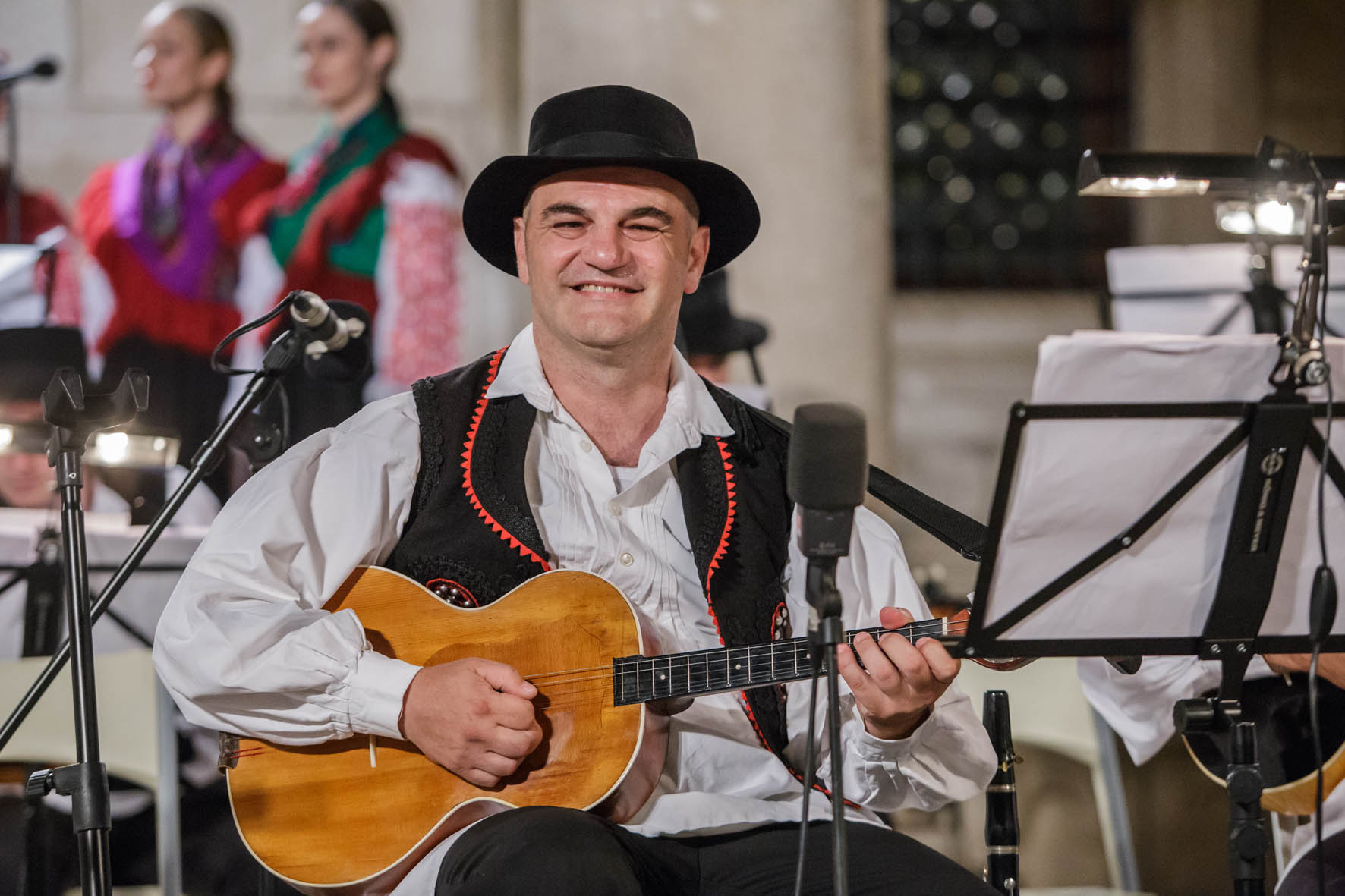
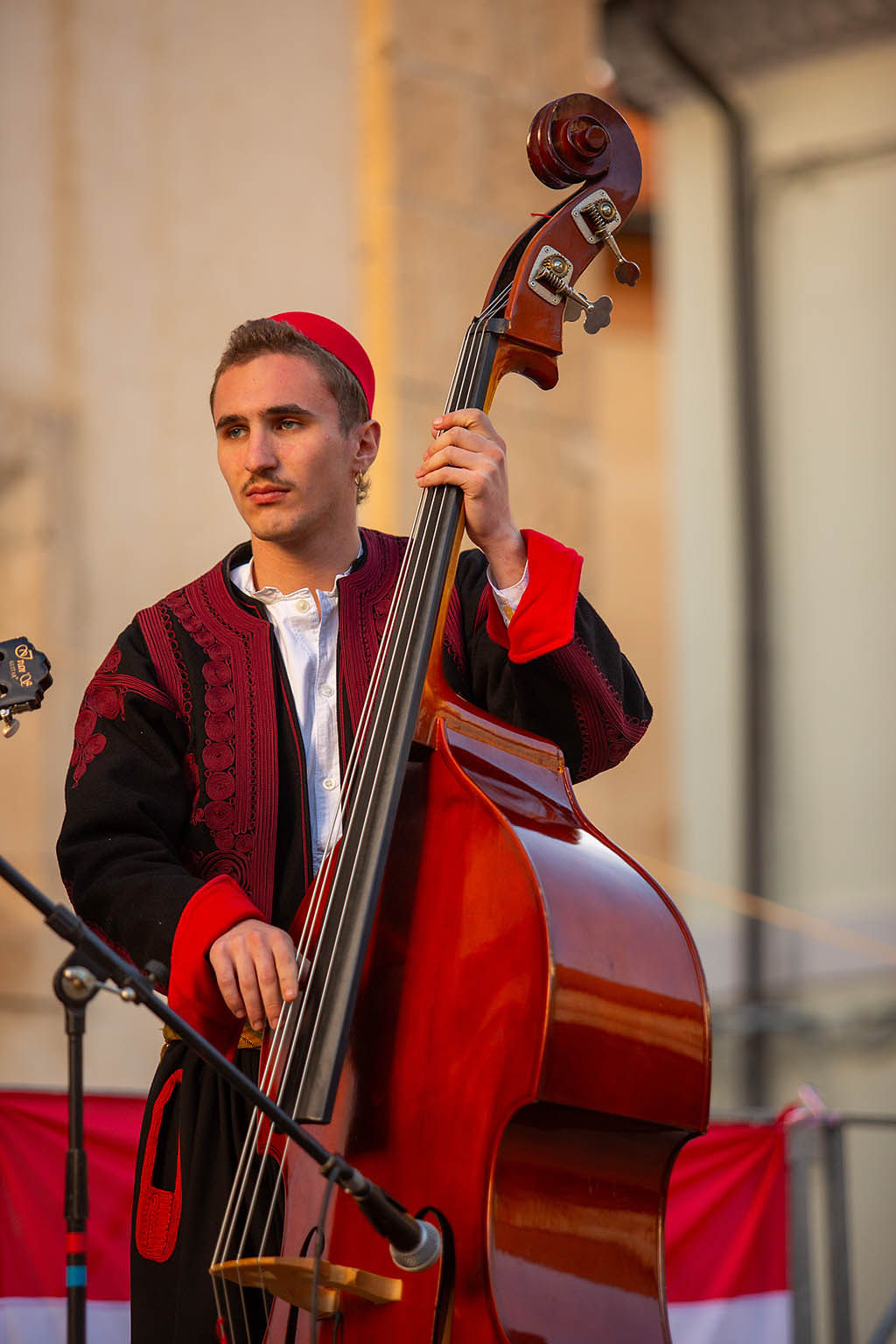
Leader of the Mandolin B Ensemble
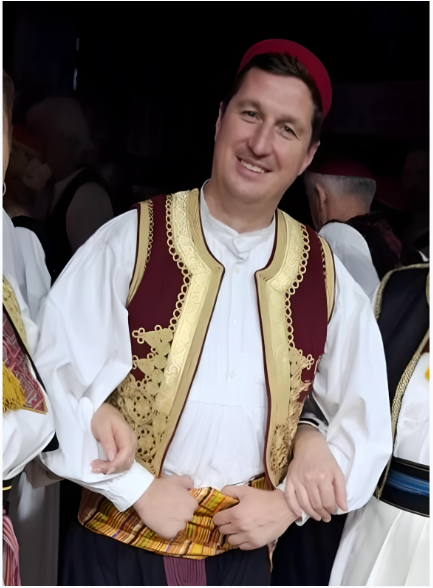
Dance Section Leader
Nikolaš and Marija Vlaškova
Nikolaš was born in the previous century. According to church records, on the fourth of April, eighteen ninety-six. In Pridvorje. On Urjak. Right where his house still stands today. He was not the only child of the late Vlašak. His older brother went to America. He married there and never returned. Nikolaš never married. Nor did Marija ever marry. She was younger than him. They called her Marija Vlaškova, and him simply Nikolaš. Both of them remained on Urjak.
Nikolaš loved company. He would play cards. By God! But more than anything, he loved the lijerica. The way he played—oh my God! And Marija would dance beside him. He would play, and she would dance. A pleasure to hear and to see. Then the professors heard about him. They began to ask around. From all sides. They wanted to record him. And they did—many times. But Marija did not like that. It seemed to her that if they recorded him, Nikolaš would no longer be needed. And once she smashed a tape recorder with a basket. The professors jumped up, asking what she had done, but Marija could not be reasoned with.
Then they wanted to take him to Zagreb. They offered him a job, an apartment, money, and that he would be on the radio every week. Everything he could have wished for! But Nikolaš would not leave Pridvorje for any amount of money. No way! The year before his death, or maybe two years before, he was in Zagreb. In the Lisinski Hall. With his people from Pridvorje. When the lights came on and before him a sea of people—endless!
He returned again to Pridvorje. To Urjak. And there he died. They buried him in the church of St. George. Together with his lijerica. Marija lived on for some time. She would always go to fetch water across the way. She always wore the house key around her neck. And then she died too.
They say there is no more Nikolaš and Marija Vlaškova. But that is not true! There they are—still alive! Nikolaš plays the lijerica! He stamps his feet! His fingers fly! And Marija dances! Dances! Turns and spins, from one side to the other! They dance potkolo, poskočica—everything resounds and rejoices. Nikolaš and Marija are alive! Alive! They are just no longer on Urjak. They are everywhere now! Again the lijerica plays and the dance goes on. Again girls and boys gather. Nikolaš and Marija did not die—no. They live on. More alive than ever before!